.svg)
August 15, 2026


August 15, 2026
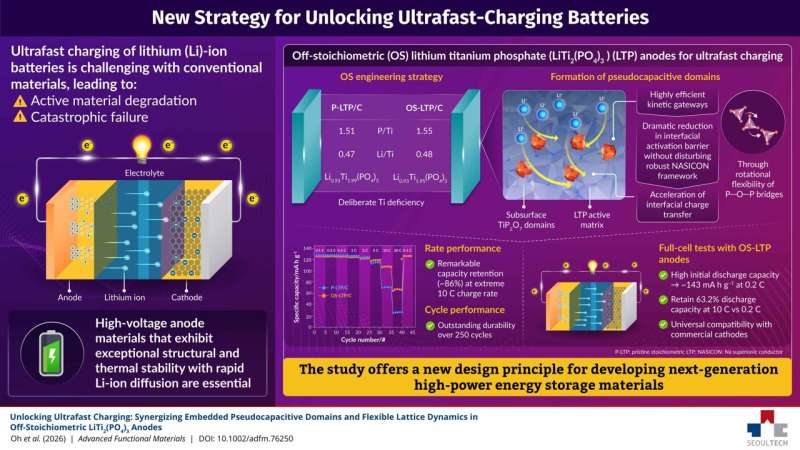
Researchers at Seoul National University of Science and Technology have developed a new anode design that could enable lithium-ion batteries to charge much faster while reducing the risk of hazardous lithium-metal plating. Fast charging can destabilize the interface between an anode and its electrolyte, causing performance loss, overheating and potentially severe failure. The team used lithium titanium phosphate, a structurally and thermally stable material, and deliberately altered its chemical composition by increasing the phosphorus-to-titanium ratio. This creates titanium-phosphate-rich regions near the particles’ surfaces that lower resistance to lithium-ion movement and provide faster pathways into the anode.
The modified anode retained 86% of its initial capacity when tested at a demanding 10C charging rate and remained stable for more than 250 cycles, substantially outperforming the unmodified material. It also worked with several high-voltage cathodes, suggesting that the approach could be adapted to different battery configurations. The researchers believe the strategy may offer a broader design method for safer, ultra-fast-charging energy-storage systems, including all-solid-state batteries, with potential applications in electric vehicles and renewable-energy grids.
Source: Tech Xplore




















.webp)

.webp)